Two-player games for family night
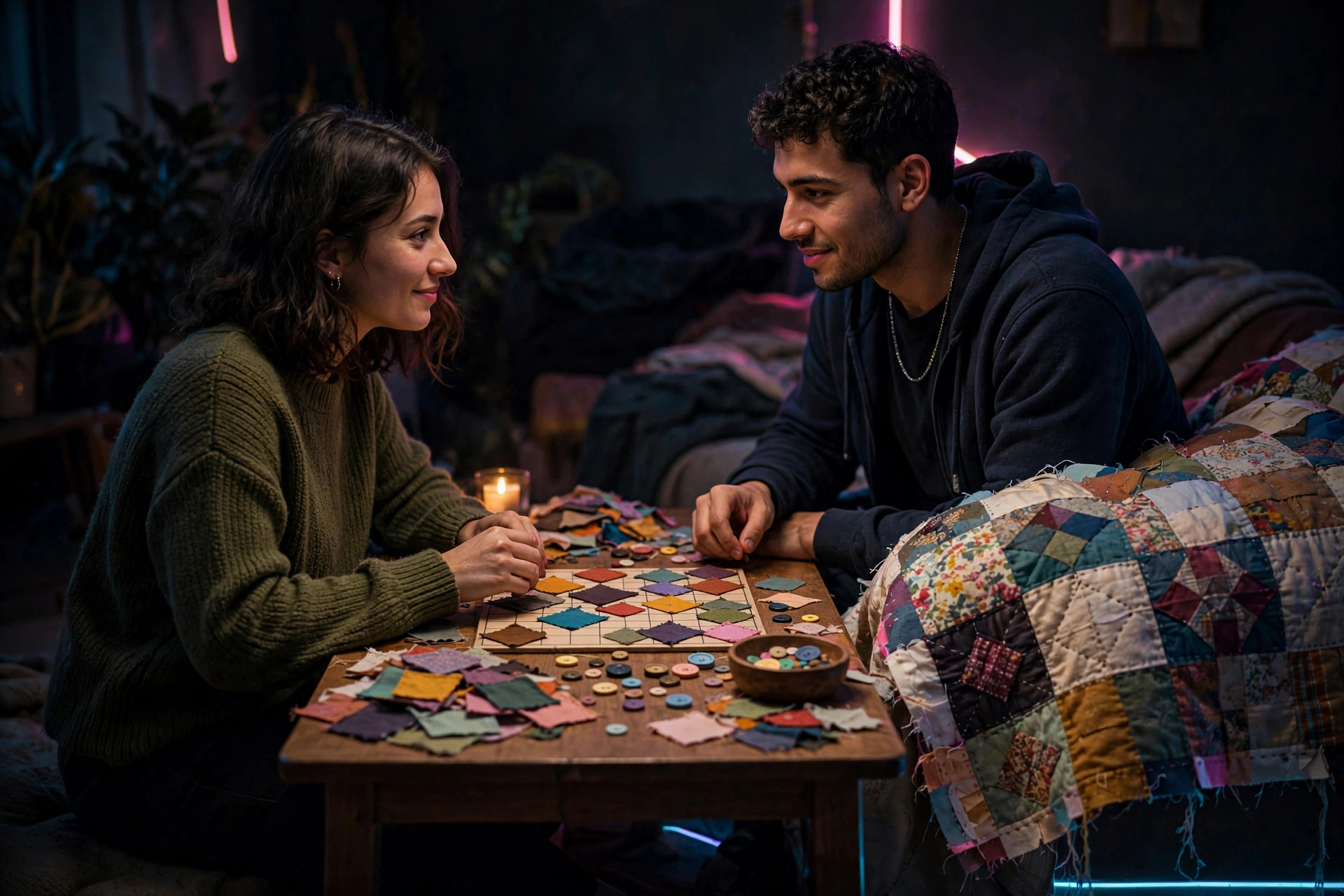
Game night does not always mean a crowd. Some of the best family gaming happens at two: a parent and a kid while dinner finishes, two siblings on a rainy afternoon, or two adults after everyone else has gone to bed. Two-player games are a distinct format, not just group games with people missing — with nowhere to hide and no downtime between turns, the right pick feels tense and quick, and the wrong pick feels like a staring contest. This guide sorts five verified boxed games by who is sitting across the table and how the two of you will actually interact, then adds a zero-cost fallback that needs nothing but a standard deck.
The five boxed picks at a glance
Specifications below were checked against publisher, retailer, and review sources on October 13, 2026.
| Game | Ages | Time | Interaction style | Best pairing |
|---|---|---|---|---|
| Patchwork | 8+ | 15–30 min | Parallel puzzle, gentle rivalry | Parent and child, calm evenings |
| Hive | 9+ | About 20 min | Direct abstract duel, no luck | Siblings, chess-curious kids |
| Jaipur | 10+ | 30 min | Trading race with luck in the draw | Older kids, couples, rematch players |
| 7 Wonders Duel | 10+ | 30 min | Deep head-to-head, three ways to win | Adults and strategy-ready teens |
| Codenames Duet | 11+ | 15–30 min | Fully cooperative wordplay | Pairs who prefer teamwork to winning |
One dated price check: 7 Wonders Duel was listed at CA$30.95 (down from a CA$37.99 list price) at Board Game Bliss on October 13, 2026. Prices change with sales, so check the listing before treating that number as current.
Gentle puzzles: Patchwork and Hive
Patchwork, designed by Uwe Rosenberg and published by Lookout Games in 2014, is competitive quilting — and it is far sharper than that sounds. Each player fills a personal 9×9 quilt board with odd-shaped fabric patches bought from a shared market. Buttons do double duty as both the currency you spend and the points you score, and every empty square left on your quilt at the end costs you. A CoopBoardGames review describes the tension plainly: every patch costs buttons and time, so the puzzle is really an economy wearing a cozy theme. Because each player works on their own board, there is almost no direct conflict — a younger player loses to a better quilt, not to an attack — which makes it the kindest head-to-head game on this list for a parent-child pairing. It plays in 15–30 minutes for ages 8 and up.
Hive, designed by John Yianni and published by Gen42 Games in 2001, removes the board entirely. Two players place and slide 22 hexagonal insect tiles — eleven per player: one Queen Bee, two Beetles, three Grasshoppers, three Soldier Ants, and two Spiders — on any flat surface, each bug moving its own way. The goal is to surround the opposing Queen Bee on all six sides while keeping yours safe. With no dice and no cards, there is no luck to blame, which older kids and chess-curious players tend to respect. A game runs about 20 minutes, the box age is 9 and up, and the set packs down small, so it works at a kitchen table, a picnic table, or a restaurant while you wait.
Head-to-head tension: Jaipur and 7 Wonders Duel
Jaipur (Space Cowboys) is a trading duel for two players, ages 10 and up, in about 30 minutes. Both players are merchants collecting, exchanging, and selling goods at a market to earn rupees; selling in larger sets earns bonus tokens, and camels — worthless to sell — are the key to making big trades. At the end of a round, the richer trader takes a Seal of Excellence, and the first player to two seals wins the game. That best-of-three rhythm is a gift for family play: lose a round and the rematch starts immediately, with the match still alive. Luck in the card draw keeps a less experienced player in contention, while timing — when to sell, when to hold — rewards the sharper trader over a full match.
7 Wonders Duel (Repos Production), designed by Antoine Bauza and Bruno Cathala, is the deepest game here. Two players aged 10 and up draft cards through three Ages to build a civilization, and there are three ways to win: military supremacy by invading the opponent's capital, scientific supremacy, or — if neither lands — the most victory points when the third Age ends. Only seven of the eight Wonders in play can be built, so denial is part of every draft. It plays in about 30 minutes, but those minutes are dense; this is the pick for two adults, or a teen who has outgrown lighter duels and wants a game that punishes autopilot. Watch the military and science tracks as carefully as your own city — most first games are lost by watching only one board.
On the same team: Codenames Duet
Not every pair wants a winner. Codenames Duet (Czech Games Edition) rebuilds the party word game as a cooperative mission for two players, ages 11 and up, in 15–30 minutes. Partners sit across a grid of words and take turns giving one-word clues, trying to contact all 15 of their agents before time runs out — while avoiding the assassins hidden in the grid before the timer runs out. The box carries 200 double-sided word cards (400 words) and 100 double-sided key cards, so the puzzle renews itself constantly. It suits word-minded pairs — partners, a parent and an older kid — who would rather finish the night saying "we cracked it" than keeping score against each other.
The zero-cost deck
No box required: a standard 52-card deck covers a whole shelf of two-player games. A standard-deck guide from Lilach Bullock sorts the classics by appetite — Gin Rummy for planning and memory, Speed for fast hands and faster reactions, War for kids and zero thinking, and Crazy Eights for beginners. Keep a deck in the kitchen drawer and the two-player night never depends on what is in the game closet. The deck is also the honest budget answer: every boxed game above earns its shelf space, but none of them is a prerequisite for a good Tuesday.
Pick by pairing, not by habit
Most failed two-player nights are a matching error, not a game error. Use this decision framework:
- Young child across the table? Choose low direct conflict. Patchwork's parallel quilts or a cooperative round of Codenames Duet for a reading 11-year-old; for younger kids, the deck games — War and Crazy Eights — ask the least and forgive the most.
- A competitive kid who hates losing to you? Choose luck with teeth. Jaipur's draw and best-of-three seals let a child win rounds honestly while you still have to play well to take the match.
- Two adults, half an hour, real depth? 7 Wonders Duel, with Hive as the travel-weight alternative when the table is small and the evening is short.
- Words over tactics? Codenames Duet turns the contest into a conversation — the rare two-player game where talking well together is the entire skill.
One house habit worth adopting whatever you pick: best-of-three for anything under 30 minutes. A single short game can hinge on one draw; a match lets the better player show it and the luckier player enjoy it, and it gives the loser a built-in, face-saving reason to say "again."
FAQ
What is a good two-player game to play with a child? Patchwork at ages 8 and up for a thinky but gentle game; below that, start with the standard deck — War and Crazy Eights need no purchase and almost no teaching.
Are there cooperative games for exactly two players? Yes — Codenames Duet is built for two and fully cooperative: both players win or lose together against the grid and the timer.
Which of these travels best? Hive. There is no board, the 22 tiles are the whole game, and any flat surface is the arena.